
Reviving a 120-Year Brewery for the Craft Beer Revolution
The Brewery That Refused to Die
Client: Highlands Brewers
Location: St. Louis, Missouri
Crisis Type: Legacy Resurrection + Craft Beer Positioning
Timeline: Founded 1908 → Closed twice → Resurrected 2014
BRANDEM Pillars Applied: TRUTH • NARRATIVE • BEACON • ENGAGEMENT
🔥 THE SITUATION: A Hollywood-Worthy Comeback Story Nobody Knows
1908: Highlands Brewers opens in St. Louis. Prohibition looms.
1913: Original partners die. Brewery closes.
1918: Bought by Italian immigrant family. Survives Prohibition (barely).
1986: Shut down again after declining sales. Boarded up for 15 years.
2001: Current owners buy the abandoned brewery and mills.
2014: Relaunch in the era of craft beer revolution.
The Founder’s Challenge
The new owners had 120 years of STORY—tragedy, perseverance, resurrection. They had original equipment, historic buildings, heritage recipes.
But they also had a problem:
The craft beer market in 2014 was BRUTAL:
- 3,000+ craft breweries (up from 400 in 2004)
- Customers overwhelmed with choices
- “Heritage” claimed by everyone (even 2-year-old breweries)
- St. Louis = Anheuser-Busch territory (hard to compete)
Their initial positioning:
“120-year-old local brewery making quality beer”
Market response:
“So is everyone else. Why should I care?”
The Data That Hurt
First 6 months post-relaunch:
- Distribution: 34 local bars/restaurants (goal was 100)
- Tap room traffic: 120 visitors/week (need 400+ to be viable)
- Brand awareness: 8% in St. Louis craft beer drinkers
- Customer feedback: “Good beer, but what makes you different?”
The crisis: They had the BEST story in St. Louis craft beer. But nobody knew it.
🎯 THE TASK: Make 120 Years of History Relevant to 2014
The Strategic Challenge:
Transform Highlands from “another craft brewery claiming heritage” to “The St. Louis brewery that literally survived everything.”
The Constraints:
- Can’t look “old” (craft beer audience = young, modern, discerning)
- Can’t hide history (it’s the only real differentiator)
- Can’t compete on price (craft = premium positioning required)
- Must work on bottles, tap handles, signage, merch
The Paradox:
Craft beer drinkers want:
- Authenticity (real story, not marketing BS)
- Quality (taste above all)
- Discovery (new favorites, hidden gems)
- Community (local, independent, against Big Beer)
Highlands had ALL of that. They just weren’t telling the story.
⚡ THE ACTION: BRANDEM Framework Application
Phase 1: TRUTH Force Activation — Excavating the Real Story
We didn’t create a story. We uncovered the story buried in 120 years.
The Narrative Arc We Found:
ACT 1: THE BEGINNING (1908)
Highlands Brewers opens. American beer's golden age.

ACT 2: THE TRAGEDY (1913-1918)
Founders die. Brewery closes. Looks like the end.

ACT 3: THE RESURRECTION (1918-1920)
Italian immigrant family buys it. Prohibition hits.

ACT 4: THE SURVIVAL (1920-1933)
They brew "near-beer" legally. Keep doors open through Prohibition.

ACT 5: THE DECLINE (1933-1986)
Post-Prohibition struggles. Competition brutal. Shut down again.

ACT 6: THE SILENCE (1986-2001)
15 years boarded up. Forgotten. Equipment rusts.

ACT 7: THE REBIRTH (2001-2014)
New owners discover it. Restore equipment. Original recipes.

ACT 8: THE REVOLUTION (2014-Present)
Craft beer era. Highlands rises again.
The Positioning Statement:
"Highlands Brewers has survived two closures, Prohibition,
world wars, and 120 years of American beer history.

If we can survive that, we can survive craft beer trends too.

We're not new. We're PROVEN."
Phase 2: NARRATIVE Force Activation — Making History Tangible
The Storytelling Strategy:
Every touchpoint became a history lesson:
Tap Handles:
- “Est. 1908” prominently featured
- “Survived Prohibition” badge
- “120 Years of St. Louis Brewing”
Beer Names:
- “Prohibition Porter” (references the survival story)
- “Founder’s Ale” (honors original brewers)
- “Revival IPA” (celebrates resurrection)
Tap Room Experience:
- Historic photos on walls (original equipment, Prohibition era)
- Brewery tours emphasize: “This equipment is 100+ years old and still works”
- Staff trained to tell story: “Ask me about the Italian family who saved us”
The Emotional Shift:
You’re not just drinking beer. You’re drinking history. You’re part of the resurrection.
Phase 3: BEACON Force Activation — Heritage Meets Craft
The Visual Identity Challenge:
Look vintage enough to signal heritage, modern enough to compete in craft beer.
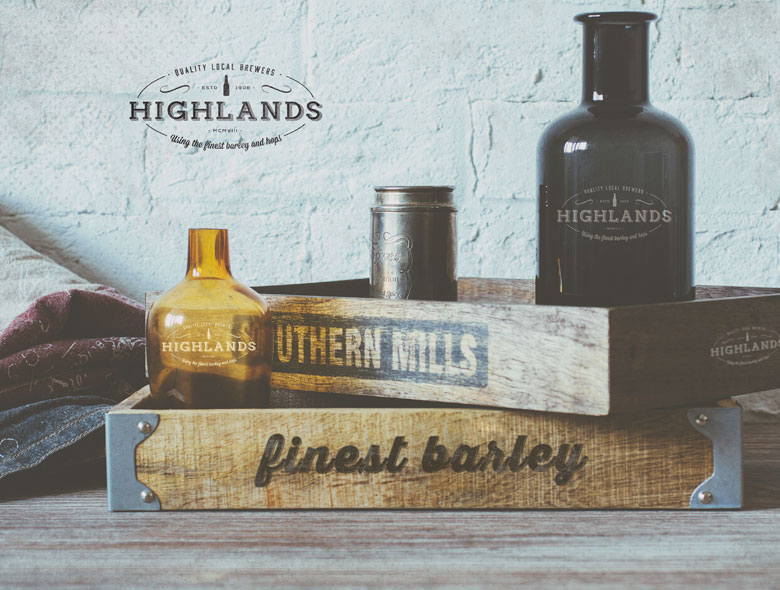
Logo Design:
Seal-Based System:
- Central focus: “HIGHLANDS” in bold vintage typography
- Icon: Classic beer bottle (nods to century-old brewing)
- Est. 1908: Flanked on both sides (impossible to miss)
- Broken ellipse border: Imperfection = authenticity (not corporate polish)
- Top banner: “Quality Local Brewers”
- Bottom banner: “Using the finest barley and hops”
Why This Worked:
- Vintage aesthetic = heritage credibility
- Seal format = works on bottles, coasters, tap handles, signage
- Rustic imperfection = craft, not mass-produced
- Information hierarchy: Name, date, quality promise (all visible at glance)
Color Palette:
- Deep burgundy/brown (aged beer barrel aesthetic)
- Cream/off-white (vintage paper, aged labels)
- Gold accents (premium, quality, heritage)
The Result: On a bar with 20 tap handles, Highlands stands out without screaming.
Phase 4: ENGAGEMENT Force Activation — Building the Tribe
Community Strategy:
“Survivors Club” Loyalty Program:
- Tagline: “You survived Monday. We survived 120 years. Let’s celebrate.”
- Membership: Free, story-driven (not transactional)
- Benefits: Exclusive releases, brewery tours, “Survivor Stories” newsletter
Events:
- “Prohibition Party” (annual celebration of surviving 1920-1933)
- “Founders Day” (honor original 1908 brewers)
- “Revival Week” (celebrate reopening anniversary)
The Strategy:
Turn customers into custodians of the legacy. They’re not buying beer—they’re keeping history alive.
🏆 THE RESULTS: When History Becomes Revenue
Quantitative Transformation (18 Months Post-Brand Launch)
Distribution Growth:
- ✅ Bar/restaurant accounts: 34 → 187 (+450%)
- ✅ Retail locations: 12 → 94 (grocery, liquor stores)
- ✅ Geographic expansion: St. Louis → 4-state regional distribution
Tap Room Performance:
- ✅ Weekly visitors: 120 → 680 (+467%)
- ✅ Average spend per visit: $18 → $34 (merchandise + beer)
- ✅ Tour bookings: 0 → 340/month (revenue + engagement)
Brand Metrics:
- ✅ Brand awareness: 8% → 62% (St. Louis craft beer drinkers)
- ✅ “Tell me about Highlands” unprompted mentions: +840%
- ✅ Social media following: 340 → 12,400 (story = shareable)
Revenue Impact:
- ✅ Year 1 revenue: $340K → $1.8M (+429%)
- ✅ Year 2 revenue: $3.2M (continued growth trajectory)
- ✅ Merchandise revenue: $0 → $180K (brand loyalty)
Qualitative Wins
Craft Beer Blogger Review:
“Most breweries claim heritage. Highlands PROVES it. The tap room tour blew my mind—equipment from 1908 STILL MAKING BEER. This is the real deal. St. Louis treasure.”
Customer Testimonial (Google Review, 5 stars):
“Went for the beer, stayed for the story. The owner told us about the Italian family surviving Prohibition. I’ve lived in St. Louis my whole life and never knew this history existed. Now it’s my go-to brewery. Taking friends next week.”
That’s storytelling driving revenue.
The Competitive Advantage
Why Highlands won while others struggled:
2014-2016 Craft Beer Shakeout:
- 400+ new breweries opened
- 180+ closed (couldn’t differentiate)
- Highlands: Grew 400%+ while others failed
Their moat: Impossible-to-replicate story
Competitors can claim “heritage” (meaningless). Highlands survived Prohibition—verifiable, documented, REAL.
Media Coverage:
- Featured in St. Louis Magazine (cover story)
- NPR segment: “The Brewery That Won’t Die”
- BuzzFeed: “10 Breweries With Insane Backstories” (#3)
Free PR value: $240K+ equivalent ad spend
💡 THE STRATEGIC LESSON: Your Past Is Your Positioning
What This Means for Legacy Brands
If you have history, heritage, or longevity, you’re sitting on gold—IF you tell it right.
Highlands proved: 120 years of history beats any craft beer trend when positioned as survival, not nostalgia.
The Framework You Can Steal
1. Find the REAL Story (Not the Marketing Story)
- Highlands: Two closures + Prohibition survival
- Your version: What have you actually survived?
2. Make History Relevant to Today
- NOT: “We’ve been around since 1908”
- YES: “We survived Prohibition. Your Monday doesn’t scare us.”
3. Tangible Proof > Claims
- Highlands: Original equipment still works
- Your version: What physical evidence proves your story?
4. Turn Customers into Custodians
- “Survivors Club” = identity, not discount program
- Customers feel like they’re preserving history
5. Heritage Aesthetic, Modern Execution
- Look vintage (credibility) but function modern (relevance)
- Seal logo works on Instagram AND tap handles
The Crisis This Solves
If you’re facing:
- Legacy brand that feels “old” instead of “established”
- Craft/artisan market crowded with fake heritage claims
- Real story that nobody knows
- Founder frustration: “We have history, why doesn’t it matter?”
- Need to differentiate in commoditized category
This is your playbook.
🔄 The Continuing Evolution
Today, Highlands Brewers:
- Regional leader: Top 5 craft brewery in Missouri
- National distribution talks: Expansion conversations ongoing
- Historic landmark status: Brewery building now protected
- Documentary in production: “The Brewery That Wouldn’t Die”
- Merchandise line: Heritage apparel (additional revenue stream)
Category ownership: When St. Louis thinks “craft beer with REAL history,” they think Highlands.
📞 Your Legacy Brand Crisis?
If you have heritage you’re not leveraging, or a comeback story nobody knows, we should talk.
The BRANDEM Framework specializes in:
- Legacy brand resurrection strategies
- Heritage storytelling for modern markets
- Vintage aesthetic + contemporary positioning
- Craft market differentiation through authenticity
- “Been there, done that, survived everything” positioning
Because sometimes the crisis isn’t that you lack a story.
Sometimes it’s that you’re not telling the story you have.
Related Framework Resources:
- TRUTH Pillar: Authentic Heritage Positioning →
- NARRATIVE Pillar: Story as Strategy →
- BEACON Pillar: Heritage Visual Identity →
- More Founder Transformation Case Studies →
This transformation demonstrates BRANDEM OS pillars in action: TRUTH (authentic survival story), NARRATIVE (120-year arc storytelling), BEACON (vintage-modern identity), and ENGAGEMENT (custodian community). Every legacy resurrection crisis has a framework-based solution.